

3D Panel Fence
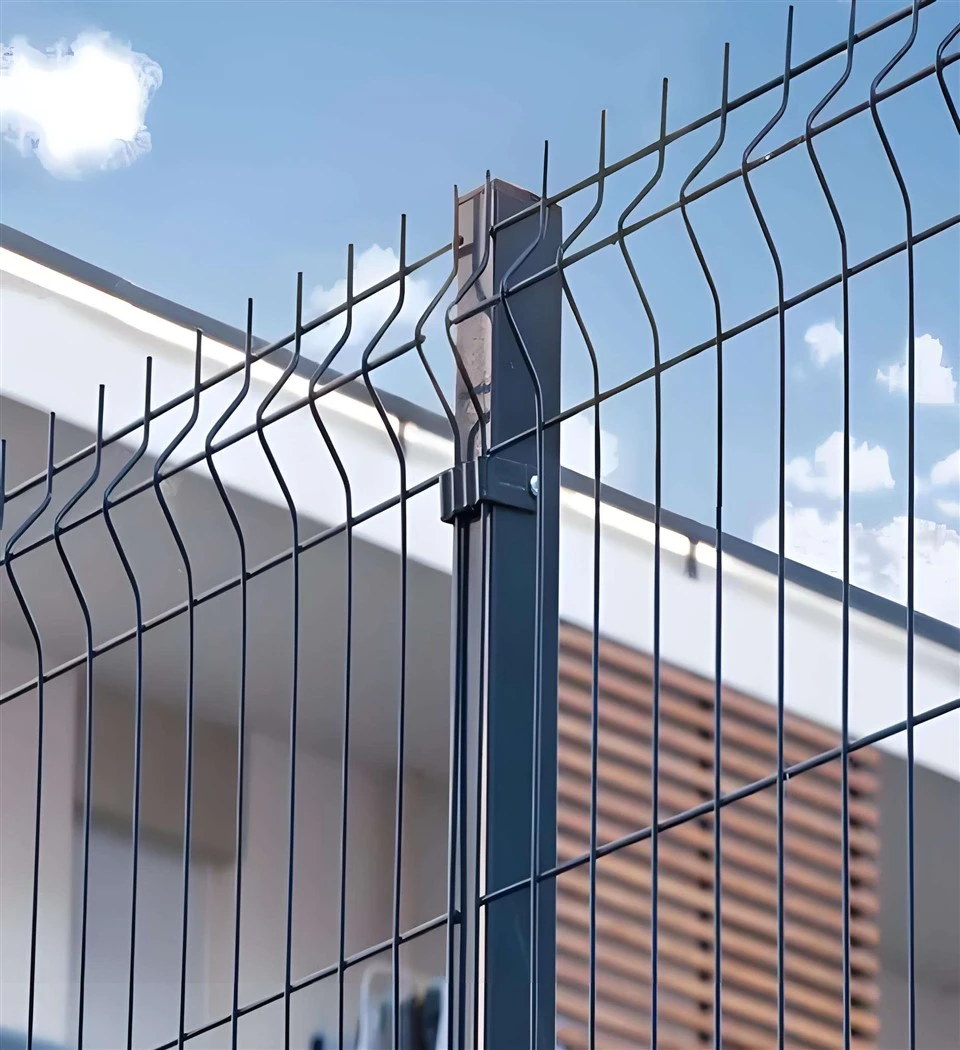
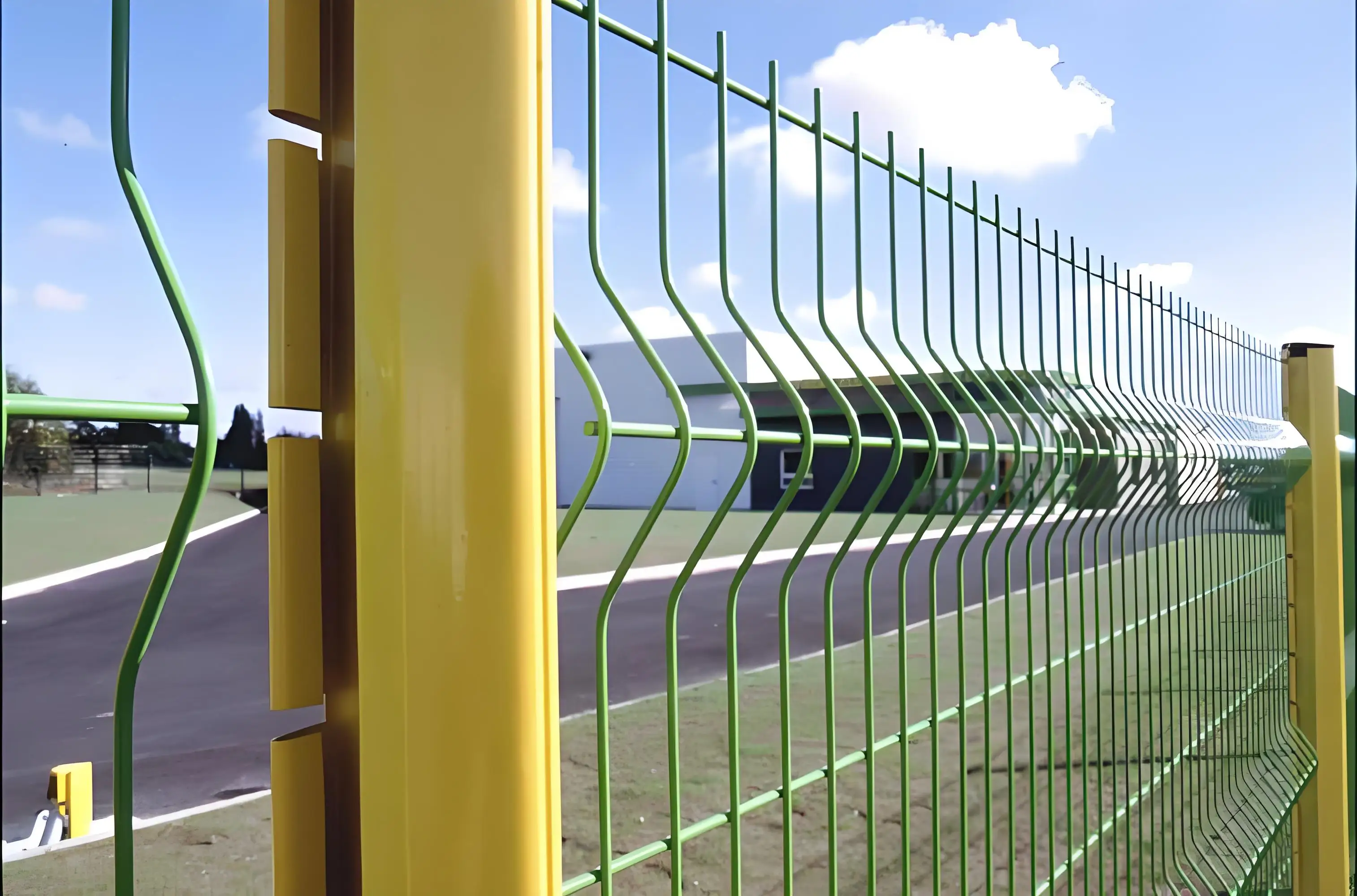
A 3D panel fence takes its name from the triangular bends pressed across the face of each panel. The bends do real work. They take the mesh out of plane, and a sheet that is no longer flat resists bending considerably better than one that is, which is why a 4 mm wire panel with three V-bends will hold a line straight where a flat panel of the same gauge starts to sag between posts.
It is the most widely installed welded mesh fence in Europe and the Middle East, and for a straightforward reason: it delivers a rigid, hard-to-climb perimeter at a lower steel weight than a flat panel of equivalent stiffness. Less steel per metre means lower freight, and on a 500 m run that shows up clearly in the landed cost.
Details Images

PVC Coated,Three Layers Protection

200mm Mesh

50mm Mesh
Finished Panels

Product Paramenters
|
Panel |
Mesh |
Wire Thickness |
Surface Treatment |
Panel Width |
Panel Height |
Fence Height |
|
Big Panel |
50x100mm 55x100mm |
4.00mm 4.50mm 5.00mm |
Gal.+PVC coated |
2.50m 3.00m |
2000mm |
2700mm |
|
2300mm |
3200mm |
|||||
|
2600mm |
3700mm |
|||||
|
530mm |
2700mm |
|||||
|
V panel |
630mm |
3200mm |
||||
|
730mm |
3700mm |
|||||
|
Y post Profile |
Wall Thickness |
Surface Treatment |
Length |
Base Plate |
Rainhat |
|
|
60x60mm |
2.0mm 2.5mm |
Gal.+PVC coated |
2700mm I+530mm V |
Available On request |
Plastic or Metal |
|
|
3100mm I+630mm V |
||||||
|
3600mm I+730mm V |
||||||

How a 3D Fence Panel Is Built
Production starts with straight low-carbon steel wire laid onto a multi-head resistance welder and fused at every crossing. Aperture tolerance is held inside 1 mm across the full panel. That tolerance is what keeps a 60 m run reading straight as it recedes, instead of rippling panel to panel.
After welding, the panel passes through a bending die that presses two, three or four V-folds up its height. Two folds suit panels up to 1230 mm, three are standard from 1530 mm to 1830 mm, and four go onto 2030 mm and taller. The folds are spaced up the panel rather than clustered at the base, so the stiffening runs through the zone where a person leaning on the mesh, or a ladder hooked over the top, puts the most load on the welds.
Posts carry the load, not the panels. Square hollow section in 50 × 50 mm, 60 × 60 mm or 80 × 80 mm is the usual choice, with wall thickness stepping up as panel height rises. A 1830 mm panel on a 60 × 60 × 2.0 mm post set 500 mm into concrete will hold its line for years. The same panel on a 1.2 mm post starts leaning within two winters, and no amount of coating will fix that.
| Item | Standard range |
|---|---|
| Panel height | 630 / 830 / 1030 / 1230 / 1530 / 1830 / 2030 / 2430 mm |
| Panel width | 2000 / 2500 / 3000 mm |
| Wire diameter | 4.0 / 4.5 / 5.0 mm (4 mm vertical + 5 mm horizontal is the standard build) |
| Mesh aperture | 200 × 50 / 200 × 55 / 150 × 50 / 100 × 50 mm |
| V-bends | 2 / 3 / 4, by panel height |
| Post | 50 × 50 / 60 × 60 / 80 × 80 mm SHS, or 70 × 100 mm peach post |
| Finish | Electro-galvanised + powder coat / hot-dip galvanised / duplex |
| Colour | RAL 6005, 7016, 9005, 9010, 9016 |
Specifying It: Height, Wire Gauge and Coating
Height comes first, and it is rarely a matter of taste. Garden boundaries and housing estates sit at 1030 mm, enough to mark a line without shutting out the view. Schools, parks and car parks generally land on 1230 or 1530 mm. Industrial yards and warehouse perimeters start at 1830 mm, while 2030 and 2430 mm get specified where the fence is the only barrier between the site and the public: substations, water treatment works, port perimeters.
Wire gauge is the second call, and it is mostly a cost one. The 4 mm vertical over 5 mm horizontal combination is where most buyers settle, since the horizontals take the bending load and the verticals only need to hold spacing. Step up to 5 mm throughout where the line takes regular knocks, meaning forklifts working close to the fence, or a boundary that runs alongside a public footpath. Replacing bent panels costs more than the wire upgrade did.
Coating is where budgets quietly go wrong, because the three tiers look identical on a sample card:
Electro-galvanised plus polyester powder coat. The standard specification, 60 to 80 μm of powder over a light zinc layer. Correct for inland sites with normal rainfall.
Hot-dip galvanised. A 40 to 80 μm zinc layer, no powder. Chosen where the fence will be cut or drilled on site, since cut edges stay protected.
Duplex, hot-dip galvanised then powder coated. The one to name within about 5 km of the coast, or around fertiliser plants and swimming pool plant rooms. It costs more per panel and is the difference between a fifteen year fence and a six year one.
Colour is the last decision and the easiest. RAL 6005 green still moves in the largest volume across Europe. RAL 7016 anthracite grey has taken over commercial and residential projects over the last five years. RAL 9005 black goes on sites that want the line to disappear against planting. We match any RAL code on request, though non-stock colours carry a setup charge and a longer run.
Packing, Loading and Installation on Site
Panels are degreased and phosphated before any coating goes on. Skipping that step is the usual cause of coating that lifts at the weld points after two seasons, so it is worth asking any supplier what their pretreatment line does. Adhesion is tested by cross-cut on each batch.
Finished panels ship flat-stacked on heat-treated wooden pallets, corners protected with cardboard, wrapped in stretch film and strapped with steel banding. Posts, clips and bolts travel in the same container, bundled separately so they can be offloaded first and staged along the line. A 40HC takes roughly 800 to 1,100 panels depending on gauge and pallet layout. Confirm that figure against your actual specification before you fix freight, because it is the question buyers ask earliest.
Post centres follow panel width: 2.5 m is the default, 3.0 m where 3 m panels are used. Posts either go 400 to 500 mm into concrete, or bolt down through a base plate where the ground is already slabbed. On sloping ground the fence is stepped rather than raked. Each post keeps its own height and the gap under the panel is absorbed by the step, which keeps the mesh square instead of pulling every opening into a parallelogram.
Fixings are the small item that generates callbacks. Plastic clips go on fast and are fine for low-spec work. Metal clips with anti-theft shear bolts are what you want on any site left unstaffed overnight: the head snaps off at torque and there is nothing left to unscrew.
FAQ
What is the difference between a 3D panel fence and a flat panel fence?
The V-bends. A flat panel needs thicker wire to reach the same rigidity, so a 3D panel is lighter per metre and cheaper to ship for equal performance. Flat panels are still chosen where the fence sits close to a wall or hedgerow and the profile would read as clutter.
Do posts, clips and gates come with the panels?
Posts and fixings are quoted together with the panels as a set. Single-leaf and double-leaf swing gates are made to match, in the same height, mesh and RAL colour, with sliding gate options for wider industrial entrances. Send the opening width and we will size the gate leaves.
Can you make non-standard heights or match a specific RAL colour?
Yes on both. Panel height, width, wire gauge and aperture can all be produced to order above a minimum quantity, and any RAL code can be matched. Non-stock colours add a powder setup charge, so on small orders it is usually better to pick from the five codes held in stock.
How long does the powder coating actually last?
On an inland site, electro-galvanised plus powder coat typically runs ten to fifteen years before the first rust spots appear at cut edges or ground level. Duplex specification roughly doubles that. Coastal exposure and de-icing salt both pull the figure down, which is why the coating tier matters more than the panel gauge in those locations.
What is the minimum order and the lead time?
Stock specifications in RAL 6005 and RAL 7016 ship from regular production runs. Custom heights, gauges or colours are made to order. Send your panel height, wire gauge, aperture, finish and quantity, and we will come back with a firm lead time and a full-set quotation including posts and fixings.
How many panels fit in a container?
It depends on wire gauge and pallet arrangement, and the number moves enough to matter. Tell us the panel size and finish you want and we will run the loading plan, then quote on a full container or a mixed container with posts and gates.
Hot Tags: 3d panel fence 1830mm high, 4mm wire, powder coated, China 3d panel fence 1830mm high, 4mm wire, powder coated manufacturers, suppliers, factory, Decorative 3D Wire Panel Fence, fence, Hot Dip Galvanized 3D Panel Fence, Powder Coated 3D Mesh Fence, privacy mesh, weld mesh security fencing


