BRC Fencing Mesh - Panel Specs, Aperture Options & Wire Gauges
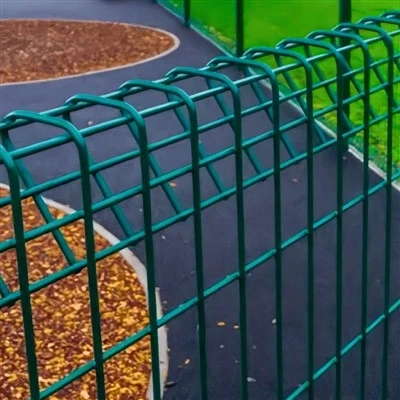
The BRC mesh panel is the core product before it becomes a fence line: a flat sheet of resistance-welded low-carbon steel wire, with the top and bottom edges rolled into closed loops. This page is about the mesh itself - wire diameter, aperture sizes, weld strength, and panel dimensions - for specifiers and fabricators who need the numbers before they buy. For the design logic behind the roll top, see our BRC fence overview; for coating details, see galvanized BRC fencing.
Three Mesh Apertures - What Each One Is For
We produce BRC panels in three standard mesh configurations. The aperture you choose changes the panel's weight, rigidity, climb-resistance and see-through ratio. Here is how they compare.

Product Details


50 × 150mm is the tightest standard BRC aperture. The 50mm vertical slot is narrower than a child's fist, which is why this mesh is the default for primary schools, childcare centers and HDB playgrounds in Singapore and Malaysia. The trade-off: more wire per square meter means more weight and a higher panel price. 75 × 200mm is our most-produced BRC mesh. The wider aperture cuts weight by roughly 20% compared to 50 × 150mm while still blocking an adult from getting a foothold. This is the go-to for most non-child-safety projects: park boundaries, factory perimeters, residential estates, parking lots. 75 × 300mm maximizes visibility and minimizes weight. You see this on highway central reserves and around utility substations where the fence is more of a boundary marker than a serious climb barrier. It is the cheapest BRC panel per square meter because it uses the least wire. |
|||||||||||||||||
Applications


Wire Diameter, Weld Strength & Panel Dimensions
All BRC mesh is woven from low-carbon steel wire (typically Q195 or Q235), drawn to the specified gauge, then resistance-welded at every intersection. The weld is what gives a BRC panel its rigidity - each joint is a fusion point, not a solder or clip, so the panel behaves as one structural sheet rather than a loose grid.
|
Spec |
Range |
|
Wire diameter |
4.0 / 4.5 / 5.0mm |
|
Wire tensile strength |
350–500MPa (low-carbon) |
|
Weld shear strength |
≥500N per joint (typical) |
|
Panel height |
0.9 / 1.2 / 1.5 / 1.8 / 2.0 / 2.4m |
|
Panel width |
2.0 / 2.5 / 3.0m |
|
Roll diameter (top/bottom edge) |
~8–12mm (closed loop) |
Panel-only supply: We ship BRC mesh panels without posts and fittings for fabricators who have their own post supply. Panels are stacked flat on pallets with cardboard separators between layers, banded with steel strapping. A 20-foot container typically holds 400–600 panels depending on height and wire gauge.
Frequently Asked Questions
Can I order a non-standard mesh size?
Yes, but there is a setup cost. The welding machine needs a new grid template for any aperture that is not one of our three standard sizes. For orders above 500 panels, the setup cost is absorbed into the unit price. Below that, we add a one-time tooling fee. In practice, most specifiers find that one of the three standard apertures fits their project - if not, 358 anti-climb mesh may be what you actually need.
What is the difference between BRC mesh and 3D panel mesh?
Both are resistance-welded wire panels, but the profiles are different. BRC has horizontal and vertical wires on the same flat plane, with rolled top and bottom edges. 3D panel fence has V-shaped horizontal folds pressed into the mesh for extra rigidity, and the edges are flat (not rolled). BRC is safer (no sharp ends) and is the Southeast Asian standard; 3D panel is more common in Europe and South America. Functionally they overlap, but the roll-top vs V-fold makes them look very different on site.
How do I know which wire diameter to specify?
4.0mm is the baseline - adequate for residential and light-commercial perimeters. 4.5mm steps up the rigidity noticeably; we recommend it for factory and industrial sites where the fence may take occasional impacts. 5.0mm is for high-security zones, high-wind areas, or projects where the spec sheet demands a minimum wire gauge. Going above 5.0mm on a BRC panel is possible but uncommon - at that point, 358 mesh is usually the more appropriate product.
Do you test weld strength on every batch?
We test weld shear on the first panel off each production run and then sample every 50th panel. Results are logged and available in the mill test certificate. If your project requires third-party weld testing, we can arrange it at the customer's cost. Typical weld shear for 4.0mm low-carbon wire exceeds 500N per joint - well above the force a person can apply by hand.
Can I buy mesh rolls instead of flat panels?
No. BRC mesh is a welded panel product - it cannot be rolled because the weld joints and the rolled edges would deform. If you need chain link mesh in rolls (woven, not welded), see our high tensile chain link fencing page. BRC is always supplied as a flat panel.
Hot Tags: brc fencing mesh, China brc fencing mesh manufacturers, suppliers, factory, Malaysia BRC Fence, brc fence, Concrete Reinforced BRC Fence, BRC Fencing Mesh, BRC Fence for Factory, Korea BRC Fence